
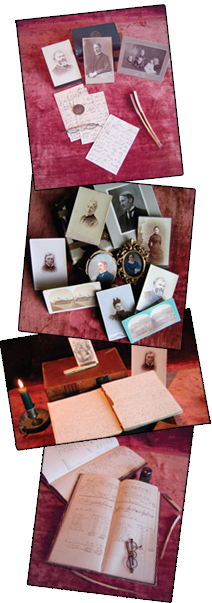

Welcome to The Family Letters
This is about three books that are all based on transcriptions of letters that have been save for many many years, some of which were only discovered when the family home of over half a century was being cleared out. Why throw anything out?!
In order of publication, they are:
|
The Family Letters Edited by: John T. B. Mudge Published 2008, 970 Pages. $35.00 per copy. |
With A Great of Love Edited by: John T. B. Mudge Published 2017, 286 Pages. $35.00 per copy. |
— Les Combats pour la Liberté The Family Letters — World War II by Gilbert H. Mudge Edited by: John T. B. Mudge Published 2021, 416 Pages. $45.00 per copy. |
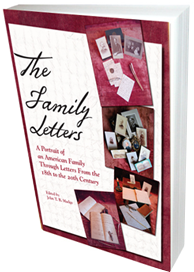


More Information about each of these books:
|
The Family Letters Edited by: John T. B. Mudge Published 2008, 970 Pages. $35.00 per copy. |
The Family Letters is a collection of letters from the late 18th century, through the 19th century, and into the early 20th century that tells the story of six generations of one family. The book includes letters from the Virginia side of the family— letters from John Cropper of Accomac and his descendants, most notably Cropper’s grandson, Henry A. Wise, Congressman, Governor, and General, and his children. The book includes the letters and diaries from the New York side of the family— the Whitesides, McKies, and Thayers of Cambridge and Troy, New York. The book includes letters from Valley Forge, the American Civil War, and the Spanish-American War. The book includes the letters between Henry Wise Hobson of Virginia and Colorado and his wife, Katherine Thayer Hobson of Troy and Colorado Springs, and then her letters written after Henry Hobson’s death in 1898 as a young widow raised her family. The Family Letters tells the story of an American family— their lives, education, interests, politics, travels, families, illnesses, births, deaths, friends, successes, failures, and more. As single letters they are very simple writings in which the family describes their sad and happy times, their ordinary lives, and their hopes for the future. As a collection of letters this is a much larger story— it is an American story. The Family Letters includes illustrations, genealogical information, and a family timeline from 1621 to 2006. Most of the material is from previously unpublished collections of letters, diaries, photographs and other materials that the family has saved over the years. However, material from other sources including the Virginia Historical Society, the Valentine Richmond History Center, the Library of Virginia, the Eastern Shore (Virginia) Public Library, Duke University, Smith College, Amherst College, the National Archives, and other institutions is also used to tell this story. |
The Family Letters
Table of Contents
Introduction
Chapter I	An Annotated Genealogy
Chapter II	1777–1838 — Virginia, Pennsylvania, and Tennessee
Chapter III	1806–1860 — Virginia, Henry A. Wise and His family
Chapter IV	1835–1844 — Early Papers from Cambridge, New York
Chapter V	1844–1850 — Letters from Cambridge and Troy, Part One
Chapter VI	1851–1854 — Letters from Cambridge and Troy, Part Two
Chapter VII	1855–1859 — Letters from Cambridge and Troy, Part Three
Chapter VIII	1860–1861 — Letters from Cambridge and Troy, Part Four
Chapter IX	1860–1865 — Life in Virginia
Chapter X	1862–1869 — Letters from Cambridge and Troy, Part Five
Chapter XI	1866–1876 — Virginia
Chapter XII	1870–1877 — Letters from Cambridge and Troy, Part Six
Chapter XIII	1878–1880 — The Thayer Family in Colorado
Chapter XIV	The Summer of 1882 — Disease, Marriage, and Death
Chapter XV	The 1880s — A Young Lawyer Goes West
Chapter XVI	1887, Part One — A Very Busy Year
Chapter XVII	1887, Part Two — Henry Wise Hobson and the Mormon Church
Chapter XVIII	1888–1889 — Colorado
Chapter XIX	1890 — The Robert E. Lee Memorial
Chapter XX	1890–1897 — A Growing Family in Denver
Chapter XXI	1898, Part One — Henry W. Hobson and the Practice of Law
Chapter XXII	1898, Part Two — August
Chapter XXIII	1898–1916 — A Widow and Her Children

Appendices

Appendix A Timeline — Selected Dates in Family History
Appendix B  Handwriting samples
Appendix C  Selected portraits and photographs
Appendix D  Bibliography
Acknowledgements
Index
What did the family say about letters?
I particularly request you to write me by next opportunity with your own hand— and recommend you to practice reading & writing ’till I return home.
—John Cropper to his wife Margaret, Peggy, Cropper, May 29, 1778, written from Valley Forge.
I hurried on up to the P.O. with a light heart & buoyant step almost sure of the rich treasure. But on looking into Box No. 40– “lo and behold” it was empty. I was not a little disappointed.
—Francis Thayer to Catherine McKie, October 30, 1847.
Three packets have come and gone and not a note from you. Sabbath last and Thursday last I was sure of a letter– of some sign or token at least from you and none came. Did you forget to mail your letters Tuesday or Saturday to be certain of reaching our ferry at Norfolk by Friday and by Tuesday?
—Henry A. Wise to Mary Lyons, October 1, 1853.
Have you no paper? If so write.
—Catherine McKie Thayer to Sophia Whiteside McKie, 1859.
Dearest, sweetest I thank you so for all your letters and if mine seem cold remember that I am not much learned in the art of saying nice things and that my epistolary practice has been for years in the field of business correspondence…
—Henry Wise Hobson to Katherine Thayer Jermain, November 12, 1887
I spent yesterday straightening up my receipts etc. and last evening I looked over a box of letters… Indeed, they came to me not only as voices of love and friendship from the past, but as spirit voices from the dear ones in Paradise…
—Annie Jennings Wise Hobson to her son, Henry Wise Hobson, December 12, 1888.
By the way, in going through Mother’s letters & papers, be careful what you throw away… I wish you would keep my letters to her. I should like to have these again, as they form a kind of diary of the past and what has been.
—Katherine Thayer Hobson to Eleanor Whiteside Hobson, the Great-Great-Great-Granddaughters of John Cropper, June 11, 1916.
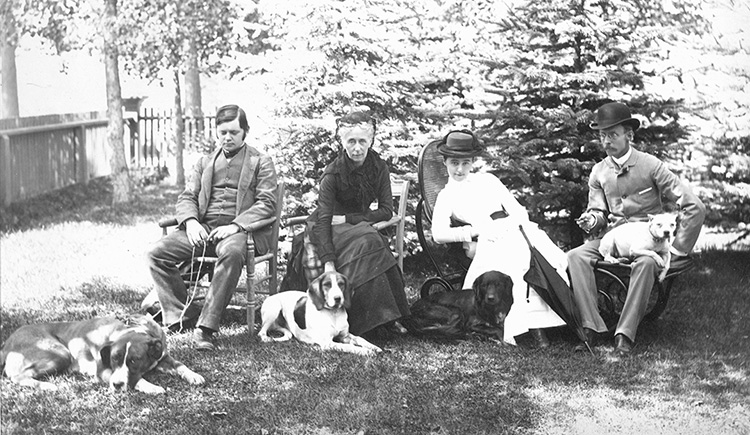 Colorado Springs— Some of the family and some dogs in Colorado about 1886.
|
With A Great of Love Edited by: John T. B. Mudge Published 2017, 286 Pages. $35.00 per copy. |
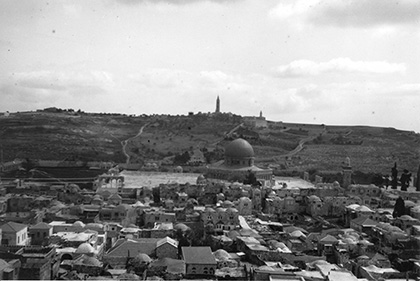
Book #2 - With A Great Deal of Love to You All — The Family Letters Alice May Horton, the youngest daughter of Byron and Elizabeth Douglas Horton, of Brooklyn, New York, was born on May 10, 1884, and died on January 13, 1919, in the flu epidemic of that year. On November 1, 1910, she married Alfred E. Mudge, a young attorney in New York. This is primarily a book of letters that Alice wrote to her family during two foreign trips— the first in 1903 and the second in 1908 – 1909. Blanche, Alice’s sister, and her husband, Stephen Trowbridge, missionaries in the Middle East, wrote the letters in the appendix about that time period. Alice’s parents, siblings, husband, and three small children survived her. Alice’s living descendants today include six Grandchildren, five Great-Grandchildren, ten Great-Great-Grandchildren, and many nieces and nephews of different generations of an extended family. Table of Contents Preface Introduction Chapter 1 — Alice’s Ancestors and Family Chapter 2 — Scotland, 1903 Chapter 3 — Scotland and Europe, 1908 Chapter 4 — Constantinople and Aintab, 1908 Chapter 5 — Aintab, 1908 – 1909 Chapter 6 —The Holy Lands and Egypt, 1909 Chapter 7 — Marriage and Children Chapter 8 — Influenza, 1919 Chapter 9 — Alice’s Children Grow Up Appendix — The Crisis of April 1909 Letters by Stephen Trowbridge and Blanche Horton Trowbridge |
|
|
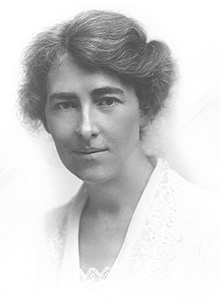
Alice Horton Mudge and one of her pictures taken in Jerusalem in 1909.
|
— Les Combats pour la Liberté The Family Letters — World War II by Gilbert H. Mudge Edited by: John T. B. Mudge Published 2021, 416 Pages. $45.00 per copy. |
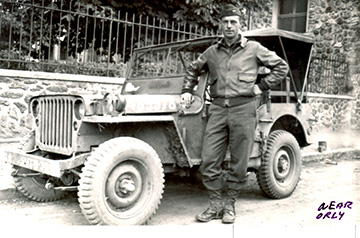
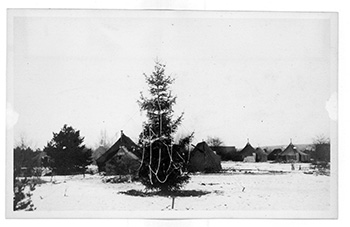
Book #3 -- The Fight for Liberty — Les Combats pour la Liberté The Family Letters — World War II These are the letters between Gilbert, (Bert), and Eleanor Mackenzie Mudge from 1940 to 1945, their marriage in Cooperstown, New York, in 1941, and then Bert’s service during World War II in Europe while Eleanor was in America. In 1961 they re-established contact with the Haize family in Carentan, France, on whose farm Bert’s squadron had built its airfield and been based soon after D-Day. A monument to the airmen who flew from that airstrip but died in the Fight for Liberty was dedicated there in 1989 on the forty-fifth anniversary of D-Day. This is that story in their letters, Claude Haize’s recollections of that time, other historical documents, and headlines from The New York Times. The Fight for Liberty — Les Combats pour la Liberté Table of Contents Introduction & Chronology Chapter 1 Our Story Begins, 1940-1941 Chapter 2 Army Training, 1942-1943 Chapter 3 To England, 1944 Chapter 4 On To France, June 1944 Chapter 5 France, Fall 1944 Chapter 6 On to V-E Day, Winter – Spring, 1944-1945 Chapter 7 Home to America, May 1945 Chapter 8 Mes Souvenirs by Claude Haize Translation by Annabelle Cone Chapter 9 Retrospective Thoughts Chapter 10 The Dedication of the Memorials, June 6 & 7, 1989 Chapter 11 Epilogue |
|
|
Ordering:
Book #1 The Family Letters
Edited by John T. B. Mudge
Price: $35.00 per copy.
Shipping charges per book:  USPS $10.00.
Contact us for shipping charges if more than three copies are ordered.
Larger orders are shipped UPS.
Book #2 With A Great Deal of Love to You All — The Family Letters
by Alice May Horton.
Edited by John T. B. Mudge
Price:  $35.00 per copy.
Shipping charges per book:  USPS $10.00.
Contact us for shipping charges if more than three copies are ordered.
Larger orders are shipped UPS.
Book #3 -- The Fight for Liberty — Les Combats pour la Liberté The Family Letters — World War II
By Gilbert H. Mudge & Eleanor M. Mudge with Claude Haize
Edited by John T. B. Mudge
Price: $45.00 per copy.
Shipping charges per book:  USPS $10.00.
Contact us for shipping charges if more than three copies are ordered.
Larger orders are shipped UPS.
Payment— Our bills have to be paid, and we need to be paid in order to pay those bills.
For that reason, we require that all orders be pre-paid. We have had some bad experiences when we have extended credit in the past. For example: We have shipped to some bookstores and then been told that, “It is very difficult to pay you small publishers.” That’s funny— it was easy to order from us, receive the shipment, sell it to the customer and take the customer’s credit card, but it was difficult to then pay the bill for the book. Amazon?? Well, we are still waiting for payment of a shipment that we made to Amazon over thirty (30) years ago! We gave up on that. We have shipped to some wholesalers who have then adjusted the bills by not paying for shipping and taken a larger discount than we gave them. We have given some bookstores “credit” and sent them an invoice with a small shipment only to next hear from a bankruptcy court— You guessed it— We were one of many unsecured creditors. That’s right, the lawyers handling the bankruptcy were well paid, but the vendors that supplied the sold inventory were left out in the cold. So, we are sorry, but it is just easier to require that everyone pay up front. You can either use PayPal or send us a check. We find that this just works better for everyone. This way, we will not be an unsecured creditor in case you go into bankruptcy, and that makes us feel better. Thank you for your cooperation.
